AI Call Deflection and Agentic Voice on Enterprise VoIP
Which calls an AI can genuinely handle on the VoIP platform you already run, how to design the conversation, when to hand off, and how payments stay inside compliant boundaries.
AI call deflection works when you point it at the right calls, the high-volume, repetitive, structured requests where the caller wants a fast answer more than a human voice. It fails when you aim it at everything and force people through a robot to reach help they actually need. The skill is knowing the difference, designing the conversation around it, and building a clean handoff for the rest.
The good news is that this rides on the phone system you already operate. Whether you run Asterisk, FreeSWITCH, Kamailio, 3CX, or another SIP and PBX stack, an agentic voice layer connects to what is in place instead of replacing it. Here is what we have learned about doing it well.
Identify which calls you can actually deflect
Not every call belongs to an AI. The ones worth deflecting share a few traits. They are frequent, they follow a predictable structure, and the answer lives in a system the agent can query.
Strong candidates:
- Order status and tracking lookups.
- Appointment or reservation booking, changes, and cancellations.
- Account balance and basic billing questions.
- Store hours, location, and routine policy questions.
- Taking a straightforward order or reservation end to end.
Poor candidates:
- Distressed or urgent calls where empathy is the point.
- Complaints and disputes that need judgment and authority.
- Anything novel that falls outside the data the agent can reach.
We start every engagement by pulling call data and categorizing it. Often a handful of call types make up the majority of volume, and deflecting just those frees your team for the work that genuinely needs a person. Chasing 100 percent deflection is the wrong target. Deflecting the right 40 percent cleanly beats deflecting 80 percent badly.
Design the conversation, do not just script it
A good voice agent sounds like it is listening, not reading a phone tree aloud. The design difference comes down to a few principles.
- Open with intent, not a menu. Ask what the caller needs in plain language and let them answer naturally, rather than reciting "press one for" options.
- Confirm before acting. Read back the order, the appointment time, or the change before committing it. This catches both recognition errors and caller mistakes.
- Handle the off-ramp gracefully. When the caller asks for a human or the agent hits something it cannot resolve, transfer without making them repeat themselves.
- Keep turns short. Long agent monologues feel robotic and people talk over them. Short, specific prompts keep the conversation moving.
The aim is a caller who hangs up having gotten what they needed, not one who is relieved the call is over.
Know when to hand off to a human
The handoff is the part most automated systems get wrong, and it is where trust is won or lost. An agent that traps people is worse than no agent at all.
We build handoff triggers on three signals.
| Signal | What it means | What the agent does |
|---|---|---|
| Explicit request | The caller asks for a person | Transfer immediately, no questions asked |
| Repeated failure | The agent misunderstands the same request twice | Stop trying and route the call |
| Out of scope | The request falls outside what the agent may do | Route to a person, such as a refund above a set threshold or a clinical question |
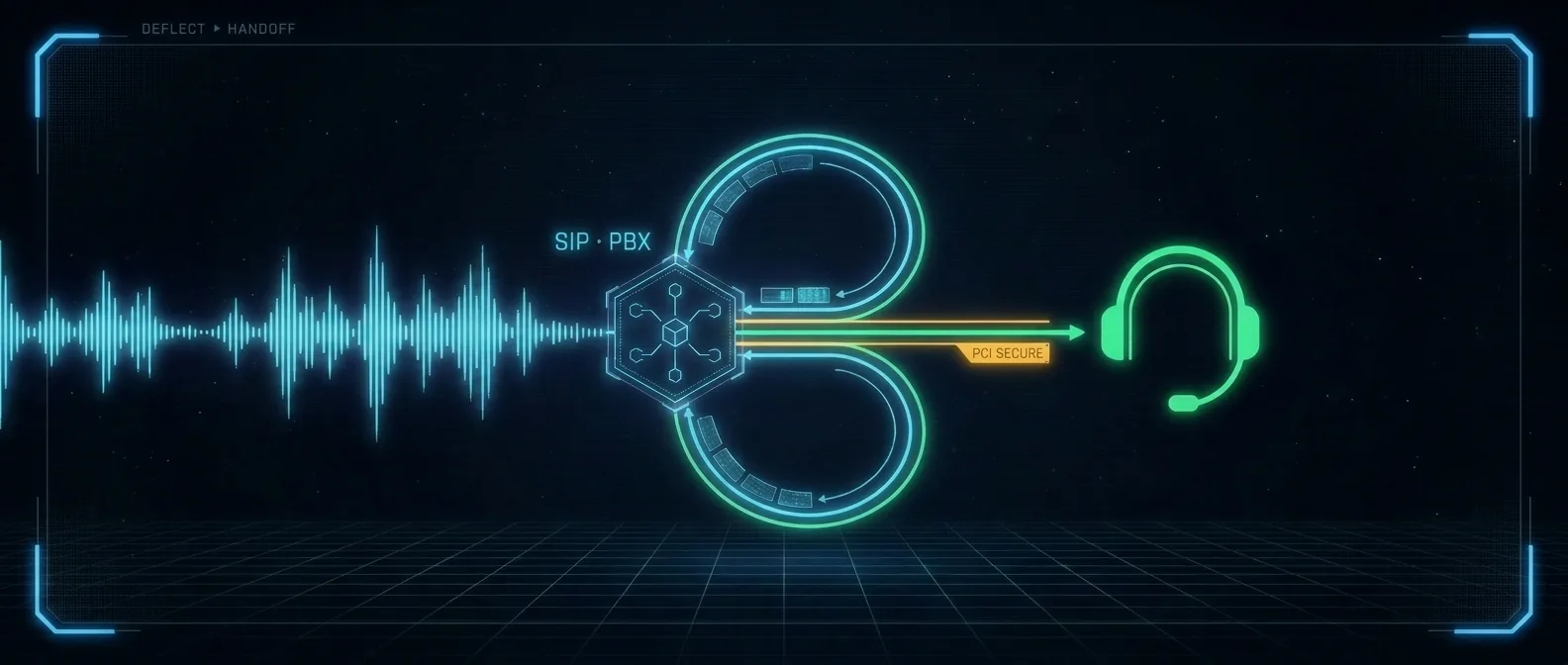
The handoff routes the call into the right queue with context attached, so the person who picks up already knows the caller's identity and what they were trying to do. This works the same way across the major platforms, since each one exposes call control and queue routing that the agent can drive. Nobody starts over. That single design choice does more for caller satisfaction than any improvement to the agent's speech.
Integrate with the systems behind the call
A voice agent that cannot touch your back-end systems can only answer general questions. The value appears when it reads and writes real data, pulling an order, booking a slot, taking a reservation, and updating the record of truth.
We integrate the agent with your order management, scheduling, or reservation systems through their APIs, with each capability scoped and logged. A booking agent can read availability and write a confirmed appointment. It cannot read a customer's full history or delete records. Every action the agent takes is recorded, so you have a clear trail of what the automation did on each call.
A simplified reservation flow shows how this comes together. First the agent gathers what it needs from the caller, the party size, the date and time, a name, and a callback number. Then it works through an ordered set of steps. It checks availability with a read-only call to the reservation system, confirms the details back to the caller, writes the reservation with a logged write call, and reads back the confirmation. Three conditions trigger a handoff to a person along the way, the caller asks for a human, the agent cannot find a matching opening after two attempts, or the caller makes a special request that falls outside what the agent is allowed to do.
Handle payments inside compliant boundaries
Taking payment over an AI voice channel is possible, and it has to be done inside PCI- and ACH-compliant boundaries or not at all. The principle is that the agent collects the intent to pay while card and bank data flow through a path designed to carry it.
In practice that means a few things.
- Card capture happens through a PCI DSS compliant payment provider, not by the agent recording numbers into a transcript.
- We pause or suppress recording and logging during the segment where sensitive payment data is spoken or entered, so card and bank details never land in your call records.
- For ACH, the agent collects authorization while the account details move through a compliant processor, keeping that data out of systems that are not built to hold it.
- The agent receives a token or a success result back, never the raw card or account number.
This keeps the convenience of paying by phone without dragging your call platform into PCI scope it was never meant to carry. The boundary holds whether the call lands on Asterisk, FreeSWITCH, or any other stack, because the sensitive data never travels through the telephony layer in the first place.
Working with us
We design and deploy agentic voice on the enterprise VoIP platforms you already run, for businesses from low call volume to enterprise, covering call deflection, order taking, reservations, and compliant payments. If you want to know which of your calls an AI could handle well and which it should leave alone, reach out and we will look at your call data with you.
Published May 28, 2026 · 6 min read